Monday, February 11, 2019

Is wine good for Alzheimer's

Caregivers, and healthcare professionals,here is some great information

Here is a great dementia resource for caregivers and healthcare professionals,

Follow alzheimersideas on twitter

The Dementia Caregiver's Little Book of Hope [Kindle Edition]

Your residents will love the Amazon Kindle Fire

Here is information on being the best caregiver you can be

Here is a way for nurses administrators, social workers and other health care  professionals to get an easyceu or two


An innovative study shows how a daily glass of wine helps clean the brain of Alzheimer's plaque. 


While a couple of glasses of wine can help clear the mind after a busy day, good research shows that it may actually help clean the mind as well. The intriguing study, which appears in the journal Scientific Reports, shows that low levels of alcohol consumption tamp down inflammation and helps the brain clear away toxins, including those associated with Alzheimer’s disease. 


“Prolonged intake of excessive amounts of ethanol is known to have adverse effects on the central nervous system,” said Maiken Nedergaard, M.D., D.M.Sc., co-director of the Center for Translational Neuromedicine at the University of Rochester Medical Center (URMC) and lead author of the study.  “However, in this study we have shown for the first time that low doses of alcohol are potentially beneficial to brain health, namely it improves the brain’s ability to remove waste.”

The finding adds to a growing body of research that point to the health benefits of low doses of alcohol. While excessive consumption of alcohol is a well-documented health hazard, many studies have linked lower levels of drinking with a reduced risk of cardiovascular diseases as well as a number of cancers. 

Wine and the Glymphatic System

Nedergaard’s research focuses on the glymphatic system, the brain’s unique cleaning process that was first described by Nedergaard and her colleagues in 2012.  They showed how cerebral spinal fluid (CSF) is pumped into brain tissue and flushes away waste, including the proteins beta amyloid and tau that are associated with Alzheimer’s disease and other forms of dementia.  Subsequent research has shown that the glymphatic system is more active while we sleep, can be damaged by stroke and trauma, and improves with exercise. 

The research study, which was conducted in mice, looked at the impact of both acute and chronic alcohol exposure.  When they studied the brains of animals exposed to high levels of alcohol over a long period of time, the researchers observed high levels of a molecular marker for inflammation, particularly in cells called astrocytes which are key regulators of the glymphatic system.  They also noted impairment of the animal’s cognitive abilities and motor skills.

Animals that were exposed to low levels of alcohol consumption, analogous to approximately 2 ½ drinks per day, actually showed less inflammation in the brain and their glymphatic system was more efficient in moving CSF through the brain and removing waste, compared to control mice who were not exposed to alcohol.  The low dose animals’ performance in the cognitive and motor tests was identical to the controls.

Low Doses Beneficial, Excessive Consumption Detrimental

“The data on the effects of alcohol on the glymphatic system seemingly matches the J-shaped model relating to the dose effects of alcohol on general health and mortality, whereby low doses of alcohol are beneficial, while excessive consumption is detrimental to overall health” said Nedergaard.  “Studies have shown that low-to-moderate alcohol intake is associated with a lesser risk of dementia, while heavy drinking for many years confers an increased risk of cognitive decline.  This study may help explain why this occurs.  Specifically, low doses of alcohol appear to improve overall brain health.” 

SOURCE:

AUTHORS:
  • Additional co-authors include Iben Lundgaard, Wei Wang, Allison Eberhardt, Hanna Vinitsky, Benjamin Reeves, Sisi Peng, Nanhong Lou, and Rashid Hussein with URMC. Nedergaard maintains research labs at both URMC and the University of Copenhagen in Denmark.
SUPPORT:
  • The study was funding with support from the Department of Navy’s Office of Naval Research, the National Institute of Neurological Disorders and Stroke, and the National Institute on Aging.

Saturday, February 9, 2019

F18-PET Scans for Alzheimer's -Are they worth the money?

Caregivers, and healthcare professionals,here is some great information

Here is a great dementia resource for caregivers and healthcare professionals,

Follow alzheimersideas on twitter

The Dementia Caregiver's Little Book of Hope [Kindle Edition]

Your residents will love the Amazon Kindle Fire

Here is information on being the best caregiver you can be

Here is a way for nurses administrators, social workers and other health care  professionals to get an easyceu or two


F18 scans offer powerful diagnostic technology, enabling doctors to "see" Alzheimer's plaque. At $3000 to $6000 per person, are they worth it? 


F18 scans work by using PET scans with fluoride-18 tracers to spot the amyloid plaques associated with Alzheimer's. 

AlzForum, the leading forum for Alzheimer's researchers, explains that Amyloid PET scans have moved into clinical use, but questions remain about how much the technology benefits patients. Initial studies suggest amyloid imaging can sharpen diagnosis, and now new research from Italy adds to these data.

What Difference Do F18 Scans Make?

In the journal JAMA Neurology, researchers led by Marina Boccardi at the University of Geneva reported that physicians in community clinics changed the diagnoses of about one-fourth of cognitively impaired patients based on amyloid scans.However, the physicians did not assign a diagnosis of Alzheimer’s disease to every patient who had brain amyloid, indicating they took other data into account as well. In addition, the doctors altered prescriptions in about one-third of the group after seeing scan data.

Large Study

This is one of the first large studies to examine what actually happens after amyloid scanning in clinical practice. The results jibe with previous, smaller studies, strengthening the argument that amyloid scanning does affect diagnosis and treatment. Nonetheless, these data leave unanswered the question of whether these changes improve a patient’s health and well-being enough to justify the scans’ hefty price tag. 

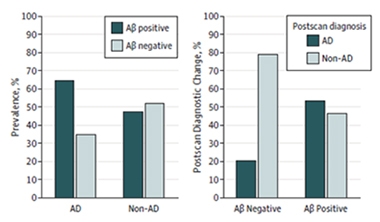
F18-PET scans revealed that about one-third of patients diagnosed with AD were amyloid-negative, while about half of patients with other diagnoses were amyloid-positive (See chart: left). Diagnoses for nearly all the Aβ-negative patients changed to non-AD (See chart: right). Only half the non-AD Aβ-positive patients were given a new diagnosis of AD. [Chart courtesy of Boccardi et al., © 2016 American Medical Association. All rights reserved.]

Medication & Treatment

The scan data affected disease management as well. Doctors prescribed an acetylcholinesterase inhibitor or memantine to about two-thirds of the amyloid-positive patients who were not previously taking these drugs, and discontinued them for about one-third of amyloid-negative patients. The physicians also changed other medications, such as antidepressants, antipsychotics, and anxiety drugs, in about 10 percent of the cohort after scanning.

Clinical Impact

F18 scans are also referred to as "amyloid PET" or "amyloid imaging", as patients take f18 tracers to allow PET scans to display the amyloid plaques behind Alzheimer's. 

“Although there may remain room for argument about cost, the findings of Boccardi and colleagues provide important insight into the real-world utility of amyloid PET,” Richard Caselli and Bryan Woodruff at the Mayo Clinic Arizona, Scottsdale, wrote in an accompanying editorial. Gil Rabinovici at the University of California San Francisco Memory and Aging Center agreed. “This study is encouraging in that it shows amyloid imaging has a clinical impact on diagnosis and patient management, and that clinicians are using the information in a nuanced way,” Rabinovici told Alzforum. 

More details at AlzForum.com . 


SOURCE:

Thursday, February 7, 2019

Alzheimer's-links to poor oral health and...

Caregivers, and healthcare professionals,here is some great information

Here is a great dementia resource for caregivers and healthcare professionals,

Follow alzheimersideas on twitter

The Dementia Caregiver's Little Book of Hope [Kindle Edition]

Your residents will love the Amazon Kindle Fire

Here is information on being the best caregiver you can be

Here is a way for nurses administrators, social workers and other health care  professionals to get an easyceu or two


The Conversation

For most people, teeth cleaning may just be a normal part of your daily routine. But what if the way you clean your teeth today, might affect your chances of getting Alzheimer’s disease in years to come?
There is an increasing body of evidence to indicate that gum (periodontal) disease could be a plausible risk factor for Alzheimer’s disease. Some studies even suggest your risk doubles when gum disease persists for ten or more years. Indeed, a new US study published in Science Advances details how a type of bacteria called Porphyromonas gingivalis – or P. gingivalis – which is associated with gum disease, has been found in the brains of patients with Alzheimer’s disease. Tests on mice also showed how the bug spread from their mouth to brain where it destroyed nerve cells.
The report in question was carried out and self-funded by founders of a US pharmaceutical company Cortexyme, which is researching the cause of Alzheimer’s and other degenerative disorders. Scientists from the San Francisco drug firm will launch a human trial later this year.

What is gum disease?

The first phase of gum disease is called gingivitis. This occurs when the gums become inflamed in response to the accumulation of bacterial plaque on the surface of the teeth.
Gingivitis is experienced by up to half of all adults but is generally reversible. If gingivitis is left untreated, “sub-gingival pockets” form between the tooth and gum, which are filled by bacteria. These pockets indicate that gingivitis has converted to periodontitis. At this stage, it becomes almost impossible to eliminate the bacteria, though dental treatment can help control their growth.
Brushing your teeth at least twice a day and flossing regularly can help to keep gum disease at bay. Shutterstock
The risks of gum disease are significantly increased in people with poor oral hygiene. And factors such as smoking, medication, genetics, food choices, puberty and pregnancy can all contribute towards the development of the condition.
Though it is important to remember that gum disease is not just the work of P. gingivalis alone. A group of organisms including Treponema denticola, Tanerella forsythia and other bacteria also play a role in this complex oral disease.

Mouth brain connection

At the University of Central Lancashire, we were the first to make the connection with P. gingivalis and fully diagnosed Alzheimer’s disease. Subsequent studies have also found this bacteria – which is responsible for many forms of gum disease – can migrate from the mouth to the brain in mice. And on entry to the brain, P. gingivalis can reproduce all of the characteristic features of Alzheimer’s disease.
Having good dental hygiene, a healthy low sugar diet and regular dental checks up can help prevent gum disease.Shutterstock
The recent US research which found the bacteria of chronic gum disease in the brains of Alzheimer’s disease patients gives additional very strong research-based evidence – but it must be interpreted in context. And the fact of the matter is that Alzheimer’s disease is linked with a number of other conditions and not just gum disease.
Existing research shows that other types of bacteria and the Herpes type I virus can also be found in Alzheimer’s disease brains. People with Down’s syndrome are also at a higher risk of developing Alzheimer’s disease, as are people who have had a severe head injury. Research also shows that several conditions associated with cardiovascular disease can increase the risk of Alzheimer’s disease. This suggests there are many causes with one endpoint – and scientists are still trying to figure out the connection.
This endpoint results in the same symptoms of Alzheimer’s: poor memory and behavioural changes. This also occurs alongside plaque buildup in the grey matter of the brain and what’s known as “neurofibrillary tangles”. These are the debris left from the collapse of a neuron’s internal skeleton. These occur when a protein can no longer perform its function of stabilising the cell structure.

Brush your teeth

The latest research adds more evidence to the theory that gum disease is one of the things that can lead to Alzheimer’s disease. But before you start panic brushing your teeth, it’s important to remember that not everyone who suffers from gum disease develops Alzheimer’s disease and not all who suffer from Alzheimer’s disease have gum disease.

To find out who is “at risk”, scientists now need to develop tests that can show the dentist who to target. Dental clinicians can then advise those people as to how they can reduce the risk of developing Alzheimer’s disease through better management of their oral health. But until then, regularly brushing your teeth and maintaining good oral hygeine is recommended.


Tuesday, February 5, 2019

Importance of oral health and resourcces

Caregivers, and healthcare professionals,here is some great information

Here is a great dementia resource for caregivers and healthcare professionals,

Follow alzheimersideas on twitter

The Dementia Caregiver's Little Book of Hope [Kindle Edition]

Your residents will love the Amazon Kindle Fire

Here is information on being the best caregiver you can be

Here is a way for nurses administrators, social workers and other health care  professionals to get an easyceu or two


  • Administration for Community Living

A GREAT DENTAL resource provides low-cost programs for American seniors. Also check out the website's free “how to” guide for communities. 


The U.S. Department of Health and Human Services (HHS), Administration for Community Living (ACL), and Office on Women’s Health (OWH) have launched their first website focused on helping communities to promote the oral health of older adults. 

Users will be able to find nearly 200 community-based oral health programs through the site’s searchable database, as well as an Oral Health Guide designed to help local organizations start or enhance their own programs. 

The need for maintaining good oral health and getting regular check-ups is widely recognized, but there are often large gaps in availability and accessibility of services for older adults, particularly for older women given their longevity and economic resources. Through this new resource, ACL and OWH aim to help close those gaps and assist communities, governments, and other organizations in improving access to high quality oral health care for older adults. 

The searchable database can help communities identify an ideal program for replication or enhancement based on diverse search criteria. A community considering the start of its own mobile dental unit, for example, could search for existing programs that fit this criterion and learn more about this type of program. 

The accompanying Oral Health Guide can further assist communities in launching or enhancing their own program. Key tips, case studies, external resources, and other sources of support are included in the Oral Health Guide. For communities that already have an oral health program in place for older adults, the Oral Health Guide can assist with expansion or enhancement. 

Both the database and Oral Health Guide are now available at https://oralhealth.acl.gov. 

Sunday, February 3, 2019

Is gum disease linked to Alzheimer's disease?

Caregivers, and healthcare professionals,here is some great information

Here is a great dementia resource for caregivers and healthcare professionals,

Follow alzheimersideas on twitter

The Dementia Caregiver's Little Book of Hope [Kindle Edition]

Your residents will love the Amazon Kindle Fire

Here is information on being the best caregiver you can be

Here is a way for nurses administrators, social workers and other health care  professionals to get an easyceu or two


Newsweek

A bacteria that causes gum disease has been linked to Alzheimer’s disease in a study scientists believe could pave the way for new treatments targeting the debilitating condition.  
An enzyme called gingipains, which the Porphyromonas gingivalis (P. gingivalis) bacteria gives off, is the “main cause of Alzheimer’s disease,” Dr. Steve Dominy, study author and associate professor at University of California, told Newsweek. However, other experts in the field responded cautiously to the findings published in the journal Science Advances.
Researchers first compared the brain tissue of patients with and without Alzheimer’s disease. They found 96 percent of 53 patients with the condition had RgpB, or a form of the gingipains enzyme known as arginine-gingipain. And 91 percent of 54 patients tested positive for Kgp, or lysine-gingipain. These were detected at levels significantly higher than the control samples, the authors said. 
DNA tests on three brains with Alzheimer’s disease and six healthy brains also had the gene associated with P. gingivalis in their tissue. The team also examined the cerebrospinal fluid and saliva of 10 patients believed to have Alzheimer’s disease, and found the P. gingivalis gene hmuY in seven, and P. gingivalis itself in all of them.
And in an experiment on mice, those dosed with gingipains had higher levels of the hallmark Alzheimer’s protein, amyloid beta, and greater damage to their neurons than those who didn’t. What’s more, when mice were treated with a drug blocking the enzymes, the neurodegeneration stopped.
Around half of adults have periodontitis. Some 10 percent experience a severe version of the disease, which erodes the gums and the bones that keep our teeth in place, the authors said. If the findings are shown to be correct, this could offer one reason for why 5.7 million Americans are currently living with Alzheimer’s disease: a figure set to rise to 14 million by 2050.
The researchers hope a drug that inhibits the spread of P. gingivalis in the brain could slow the symptoms of the neurodegenerative disorder.
Referring to tau, a protein associated with Alzheimer's disease, Dominy told Newsweek: “Studies reported in our paper indicate that P. gingivalis and gingipains can directly kill neurons, damage tau, elevate levels of beta amyloid, and increase markers of neuroinflammation.”
“In addition, our finding of DNA from P. gingivalis in the cerebrospinal fluid of living AD patients provides further evidence that P. gingivalis infects the central nervous system. Based on these findings, we believe that P. gingivalis is the main cause of Alzheimer’s disease, and the gingipains are the main drivers of Alzheimer’s disease pathology.
“These findings provide a new strategy for Alzheimer’s treatment by specifically targeting P. gingivalis and gingipains instead of amyloid beta,” he said.
However, he said the study was limited because the team has not yet determined if different strains of P. gingivalis are more virulent than others in causing brain infection. “This remains an area of active investigation,” he said.
Those concerned that poor dental health could increase their risk of Alzheimer’s disease are advised to practice good oral hygiene to preclude the prevalence of P. gingivalis in the mouth, said Dominy. But he stressed this won't prevent the brain from becoming infected by P. gingivalis.
"That is why we have created highly potent, brain penetrant, anti-gingipain small molecules to target P. gingivalis and gingipians in the brain," he said. 
Dr. David Reynolds, a chief scientific officer at the charity Alzheimer’s Research UK who did not work on the paper, commented: “The presence of a single type of bacteria is extremely unlikely to be the only cause of the condition.”
Describing the study as “well-conducted,” he explained: “Previously the P. gingivalis bacteria associated with gum disease has been found in the brains of people with Alzheimer’s but it remains unclear what role, if any, it plays in the development of the disease.”  
“We know diseases like Alzheimer’s are complex and have several different causes, but strong genetic evidence indicates that factors other than bacterial infections are central to the development of Alzheimer’s, so these new findings need to be taken in the context of this existing research,” he argued.
However, he welcomed the avenue of inquiry as no new drugs targeting Alzheimer’s have been released for over 15 years.
“It’s important we carefully assess all new potential treatments, and this drug is currently in an early phase clinical trial to establish if it is safe for people. We will have to see the outcome of this ongoing trial before we know more about its potential as a treatment for Alzheimer’s," he said. 

Studies in the past have also associated the little-understood disease to the virus which cases herpes.

Friday, February 1, 2019

Why is sunlight good for those with dementia

Caregivers, and healthcare professionals,here is some great information

Here is a great dementia resource for caregivers and healthcare professionals,

Follow alzheimersideas on twitter

The Dementia Caregiver's Little Book of Hope [Kindle Edition]

Your residents will love the Amazon Kindle Fire

Here is information on being the best caregiver you can be

Here is a way for nurses administrators, social workers and other health care  professionals to get an easyceu or two


University of Shouthampton

Sunlight improves vascular health. That's good for your heart. Discover the good things it does for your brain. 


Exposing skin to sunlight may help to reduce blood pressure and thus cut the risk of heart attack, stroke and vascular dementia, a study published in the Journal of Investigative Dermatology suggests.

Vascular dementia is one of the 3 leading causes of dementia. When it appears together with Alzheimer's disease, which it does quite often, it is called "Mixed dementia".

Sunlight Alters Nitric Oxide

Research carried out at the Universities of Southampton and Edinburgh shows that sunlight alters levels of the small messenger molecule, nitric oxide (NO) in the skin and blood, reducing blood pressure.

Martin Feelisch, Professor of Experimental Medicine and Integrative Biology at the University of Southampton, comments: “(NO) along with its breakdown products, known to be abundant in skin, is involved in the regulation of blood pressure. When exposed to sunlight, small amounts of (NO) are transferred from the skin to the circulation, lowering blood vessel tone; as blood pressure drops, so does the risk of heart attack and stroke.”

Sunlight & Blood Pressure

Put simply, what's good for the heart is good for the brain. "Heart-health" is about vascular health, which is to say, it is about blood vessels such as arteries and veins. When blood vessels pop or clog, they cause cardiovascular disease  and vasculardementia. Sunlight, by helping to lower blood pressure, should help avoid these problems. 

On the other hand, limiting sunlight exposure is important to prevent skin cancer. Notwithstanding, the authors of the study, including Dr. Richard Weller of the University of Edinburgh, suggest that going too far in minimizing exposure may be disadvantageous. It seems that one should keep a balance. Otherwise, a person who stays away from the sun too much may end up increasing the risk of prevalent conditions related to cardiovascular disease, such as vascular dementia. 

Cardiovascular disease, often associated with high blood pressure, accounts for 30 per cent of deaths globally each year. Blood pressure and cardiovascular disease are known to vary according to season and latitude, with higher levels observed in winter and in countries further from the equator, where ultraviolet radiation from the sun is lower. 

During the study, the skin of 24 healthy individuals was exposed to ultraviolet (UVA) light from tanning lamps for two sessions of 20 minutes each. In one session, the volunteers were exposed to both the UVA rays and the heat of the lamps. In another, the UV rays were blocked so that only the heat of the lamps affected the skin.

Seasonal Blood Pressure Variation

The results suggest that UVA exposure dilates blood vessels, significantly lowers blood pressure, and alters NO metabolite levels in the circulation, without changing vitamin D levels. Further experiments indicate that pre-formed stores of NO in the upper skin layers are involved in mediating these effects. The data are consistent with the seasonal variation of blood pressure and cardiovascular risk at temperate latitudes. 

Professor Feelisch adds: “These results are significant to the ongoing debate about potential health benefits of sunlight and the role of Vitamin D in this process. It may be an opportune time to reassess the risks and benefits of sunlight for human health and to take a fresh look at current public health advice. Avoiding excess sunlight exposure is critical to prevent skin cancer, but not being exposed to it at all, out of fear or as a result of a certain lifestyle, could increase the risk of cardiovascular disease. Perhaps with the exception of bone health, the effects of oral vitamin D supplementation have been disappointing. 

“We believe that NO from the skin is an important, so far overlooked contributor to cardiovascular health. In future studies we intend to test whether the effects hold true in a more chronic setting and identify new nutritional strategies targeted at maximizing the skin’s ability to store NO and deliver it to the circulation more efficiently.” 

Wednesday, January 30, 2019

Can the Alzheimer's gene be neutralized

Caregivers, and healthcare professionals,here is some great information

Here is a great dementia resource for caregivers and healthcare professionals,

Follow alzheimersideas on twitter

The Dementia Caregiver's Little Book of Hope [Kindle Edition]

Your residents will love the Amazon Kindle Fire

Here is information on being the best caregiver you can be

Here is a way for nurses administrators, social workers and other health care  professionals to get an easyceu or two


:
Apoe4 genes increase Alzheimer's risk by 10 times. UT Southwestern researchers succeeded in neutralizing important gene effects. The breakthrough opens doors to developing a pill to lower risk in 50% to 80% of gene carriers. 


DALLAS – UT Southwestern researchers have succeeded in neutralizing what they believe is a primary factor in late-onset Alzheimer’s disease, opening the door to development of a drug that could be administered before age 40, and taken for life, to potentially lower risk of the disease in 50 to 80 percent of at-risk adults


Apolipoprotein E (ApoE) is a protein that carries fatty substances called lipids and cholesterol around the brain and plays an important role in repair mechanisms. There are three major forms of ApoE (i.e., ApoE2, ApoE3, and ApoE4); individuals who carry ApoE4 are up to 10 times more likely to develop Alzheimer’s than those with ApoE2 and ApoE3 forms. ApoE4 promotes accumulation of the b-amyloid protein that causes the characteristic plaques seen in the brains of Alzheimer’s patients.

Prevent Alzheimer's from Manifesting

UT Southwestern molecular biologist and Alzheimer’s expert Dr. Joachim Herz, lead author of the study, which was published in the November issue of eLife, said the goal of his team is to prevent the disease from ever manifesting. Late-onset Alzheimer’s generally is diagnosed about age 65 and is the most common cause of dementia in the elderly. “If we can negate the ApoE4 process early, we may be able to prevent late-onset Alzheimer’s altogether for many people so that they will never get sick,” Dr. Herz said. 

ApoE4 has been shown to suppress and trap synaptic receptors within intracellular vesicles. However, how the ApoE4 gets trapped has remained a mystery until now. 

According to Dr. Herz, ApoE4 is the root cause of a “traffic jam” inside the cells that take up ApoE4 and this is associated with reduced recycling of intracellular endosomal transport vesicles. UTSW researchers found that lowering the pH of these endosomes, i.e., by making them more acidic, cleared the traffic jam: The scientists were able to completely reverse the ApoE4-induced recycling block in mice through pharmacological and genetic inhibition of the NHE6 protein, which acts to make the endosomal vesicles less acidic.

Clearing the Brain's "Traffic Jam"

These findings suggest a novel potential therapeutic approach for the prevention of late-onset Alzheimer’s disease, Dr. Herz said. The vesicle traffic jam due to the selective loss of solubility of ApoE4 likely is the earliest mechanism at which the protein negatively affects nerve cells, Dr. Herz said. 

Most Alzheimer’s research has focused on halting the formation of amyloid and tau protein aggregates once they exist in the brain and degeneration has already begun. “Our approach in this study was to stop the overall degeneration process earlier; that is, before the formation of these aggregates,” Dr. Herz said.

Inexpensive Pill

The next step is to develop tailor-made, small molecule inhibitors that can enter the brain efficiently and selectively block NHE6, he added. 

“The beauty of NHE inhibitors is that these are small molecules that can be produced inexpensively and thus made widely available, in contrast to the more elaborate antibody-based therapies that are currently being evaluated in clinical trials. A simple pill could someday neutralize the risk of late-onset Alzheimer’s disease just as readily available statins are able to reduce the risk of cardiovascular disease,” Dr. Herz said. 


SOURCE:
  • UT Southwestern Medical Center
    UT Southwestern, one of the premier academic medical centers in the nation, integrates pioneering biomedical research with exceptional clinical care and education. The institution’s faculty has received six Nobel Prizes, and includes 22 members of the National Academy of Sciences, 17 members of the National Academy of Medicine, and 15 Howard Hughes Medical Institute Investigators. The faculty of more than 2,700 is responsible for groundbreaking medical advances and is committed to translating science-driven research quickly to new clinical treatments. UT Southwestern physicians provide care in about 80 specialties to more than 105,000 hospitalized patients, nearly 370,000 emergency room cases, and oversee approximately 2.4 million outpatient visits a year.

Blog Flux Directory
alzheimersideas - whereIstand.com

Fitness is important in dementia prevention. Click below for more info