Here is a great dementia resource for caregivers and healthcare professionals,
Follow alzheimersideas on twitter
The Dementia Caregiver's Little Book of Hope [Kindle Edition]
Your residents will love the Amazon Kindle Fire
Here is information on being the best caregiver you can be
Here is a way for nurses administrators, social workers and other health care professionals to get an easyceu or two
Salk researchers
J147 is a derivative of curry's turmeric spice. It beat the Alzheimer's drug Aricept (generic: donepezil) on several memory tests. The Salk Institute says it may benefit Parkinson's, Huntington's & vascular dementia. Find out how J147 prevented memory loss & slowed Alzheimer's.
LA JOLLA, CA—A drug developed by scientists at the Salk Institute for Biological Studies, known as J147, reverses memory deficits and slows Alzheimer's disease in aged mice following short-term treatment.
J147 was developed at Salk in the laboratory of David Schubert, a professor in the Cellular Neurobiology Laboratory.
India has Less Alzheimer's than the USA
Dr. Schubert said,"It's been known for a long time that people in India don't get very much Alzheimer's relative to what happens in the United States and the rest of the world.
"One of the curiousities about the diet in India is that they eat a lot of curry. A major spice in curry is turmeric. A major component of turmeric is curcumin.
"Curcumin has been around for a while. It is an FDA-Approved drug for cancer. A friend of mine in Los Angeles, Greg Cole, found that if you give curcumin to very similar mice to what this study's author has been using, they get a little better, the (Alzheimer's) plaques go away.
"The problem with curcumin is that it is not a great drug, in the sense that it gets degraded very rapidly. It's availability is quite low in the bloodstream and the brain.
"We decided to make a better version of this.We did a lot of medicinal chemistry. We came up with J147."
"Strong Potential to Slow Alzheimer's"
Lead study author Marguerite Prior, a research associate in Salk's Cellular Neurobiology Laboratory, added,"J147 is an exciting new compound because it really has strong potential to be an Alzheimer's disease therapeutic by slowing disease progression and reversing memory deficits following short-term treatment."Because of its broad ability to protect nerve cells, the researchers believe that J147 may also be effective for treating other neurological disorders, such as Parkinson's disease, Huntington's disease and amyotrophic lateral sclerosis (ALS), as well as vascular dementia from stroke, although their study did not directly explore the drug's efficacy as a therapy for those diseases.
The findings, published in the journal Alzheimer's Research and Therapy, may pave the way to a new treatment for Alzheimer's disease in humans.
Despite years of research, scientists are still seeking the first disease-modifying drugs for Alzheimer's. Current FDA-approved medications include
- Aricept® (generic donepezil)
- Razadyne® (generic galantamine)
- Exelon® (generic rivastigmine, sometimes branded as Ebixa® in Europe)
Protecting Brain Cells
Professor Schubert and his colleagues bucked the trend within the pharmaceutical industry, which has focused on the biological pathways involved in the formation of amyloid plaques, the dense deposits of protein that characterize the disease. Instead, the Salk team used living neurons grown in laboratory dishes to test whether their new synthetic compounds, which are based upon natural products derived from plants, were effective at protecting brain cells against several pathologies associated with brain aging.From the test results of each chemical iteration of the lead compound, they were able to alter their chemical structures to make them much more potent. Although J147 appears to be safe in mice, the next step will require clinical trials to determine whether the compound will prove safe and effective in humans. Professor Schubert said,
"Alzheimer's disease research has traditionally focused on a single target, the amyloid pathway, but unfortunately drugs that have been developed through this pathway have not been successful in clinical trials. Our approach is based on the pathologies associated with old age - the greatest risk factor for Alzheimer's and other neurodegenerative diseases - rather than only the specificities of the disease."
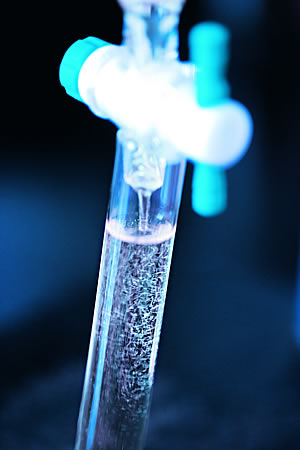
Salk scientists developed J147, a synthetic drug shown to improve memory and prevent brain damage in mice with Alzheimer's disease.
Images: Courtesy of the Salk Institute for Biological Studies
In a different experiment, the scientists tested J147 directly against Aricept (generic donepezil), the most widely prescribed Alzheimer's drug, and found that it performed as well or better in several memory tests.
"In addition to yielding an exceptionally promising therapeutic, both the strategy of using mice with existing disease and the drug discovery process based upon aging are what make the study interesting and exciting," says Schubert, "because it more closely resembles what happens in humans, who have advanced pathology when diagnosis occurs and treatment begins." Most studies test drugs before pathology is present, which is preventive rather than therapeutic and may be the reason drugs don't transfer from animal studies to humans.
Helps New Neurons Grow & Connect
Prior and her colleagues say that several cellular processes known to be associated with Alzheimer's pathology are affected by J147, including an increase in a protein called brain-derived neurotrophic factor (BDNF), which protects neurons from toxic insults, helps new neurons grow and connect with other brain cells, and is involved in memory formation. Postmortem studies show lower than normal levels of BDNF in the brains of people with Alzheimer's.The Salk researchers say that J147, with its memory enhancing and neuroprotective properties, along with its safety and availability as an oral medication, would make an "ideal candidate" for Alzheimer's disease clinical trials. They are currently seeking funding for such a trial.
MORE INFORMATION:
Other researchers on the study were Richard Dargusch, Jennifer L. Ehren and Chandra Chiruta, of the Salk Institute.
The work was supported by the Alzheimer's Drug Discovery Foundation, the Bundy Foundation, the Fritz Burns Foundation, the George E. Hewitt Foundation, the Alzheimer's Association, and the National Institutes of Health.
About the Salk Institute for Biological Studies:
The Salk Institute for Biological Studies is one of the world's preeminent basic research institutions, where internationally renowned faculty probe fundamental life science questions in a unique, collaborative, and creative environment. Focused both on discovery and on mentoring future generations of researchers, Salk scientists make groundbreaking contributions to our understanding of cancer, aging, Alzheimer's, diabetes and infectious diseases by studying neuroscience, genetics, cell and plant biology, and related disciplines.
Faculty achievements have been recognized with numerous honors, including Nobel Prizes and memberships in the National Academy of Sciences. Founded in 1960 by polio vaccine pioneer Jonas Salk, M.D., the Institute is an independent nonprofit organization and architectural landmark
Other researchers on the study were Richard Dargusch, Jennifer L. Ehren and Chandra Chiruta, of the Salk Institute.
The work was supported by the Alzheimer's Drug Discovery Foundation, the Bundy Foundation, the Fritz Burns Foundation, the George E. Hewitt Foundation, the Alzheimer's Association, and the National Institutes of Health.
About the Salk Institute for Biological Studies:
The Salk Institute for Biological Studies is one of the world's preeminent basic research institutions, where internationally renowned faculty probe fundamental life science questions in a unique, collaborative, and creative environment. Focused both on discovery and on mentoring future generations of researchers, Salk scientists make groundbreaking contributions to our understanding of cancer, aging, Alzheimer's, diabetes and infectious diseases by studying neuroscience, genetics, cell and plant biology, and related disciplines.
Faculty achievements have been recognized with numerous honors, including Nobel Prizes and memberships in the National Academy of Sciences. Founded in 1960 by polio vaccine pioneer Jonas Salk, M.D., the Institute is an independent nonprofit organization and architectural landmark


