Showing posts with label alzheimersideas. Show all posts

Wednesday, April 24, 2019

How to pick the right gift for those with dementia for Mother's Day

Activities directors and other healthcare professionals here is a great dementia resource for caregivers and healthcare professionals.

Here is information on being the best caregiver you can be

Here is a way for nurses administrators, social workers and other health care  professionals to get an easyceu or two


Image result for adorable photos for those with dementia

Choosing the right present for someone with Alzheimer's disease or a related dementia is certain to give him/her joyful times independently or with a loved one. Here are some tips on how to pick a perfect gift. You can give a gift anytime, but Mother's Day is coming soon which is a perfect opportunity to give that special someone a special gift.


Over 5.4 million Americans are living with dementia. Is one of them someone you know or a client of yours? Get him/her or anyone with Alzheimer's disease or another dementia, a gift that will keep on giving
Of course, person appropriate offerings are the best. This means matching a gift to a person's interests and abilities, However, there are some presents that will make them smile no matter what.

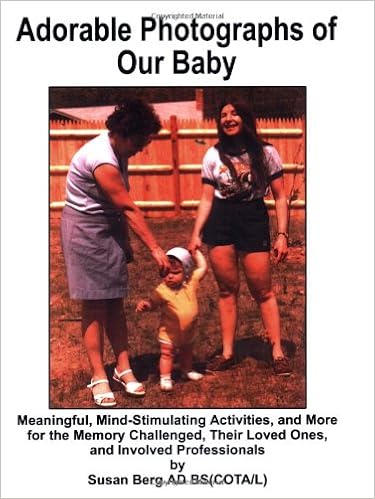
One such gift is a book by Susan Berg called Adorable Photographs of Our Baby -- Meaningful, Mind-Stimulating Activities and More for the Memory Challenged, Their Loved Ones and Involved Professionals, This book features baby photographs that seniors with dementia love. This book shares a plethora of ideas and resources for you. Mothers especially love babies

Another gift dementia persons will fancy is a classic musical video or DVD especially a musical love story. A classic movie of this type is Rogers and Hammerstein's movie, Carousel (1945) or South Pacific (1949)


click here for the whole story

Wednesday, November 14, 2012

Thanksgiving Activities For Those With Dementia

Here is a great dementia resource for caregivers and healthcare professinals,

You will love the Amazon Kindle Fire

Here is information on being the best caregiver you can be

Here is a way for nurses administrators, social workers and other health care professionals to get an easyceu or two

Follow Alzheimers1 on twitter

How to Eat Right, Keep Calm and Enjoy Thanksgiving with Someone Who Has Alzheimer's Disease or a Related Dementia How to Eat Right, Keep Calm and Enjoy Thanksgiving with Someone Who Has Alzheimer's Disease or a Related Dementia

According to the National Institute of Mental Health(NIMH) over five million Americans are living with Alzheimer's disease or a related dementia. Countless others are impacted by their illness. Studies have shown that eating right staves off dementia and slows the decline of someone who already has Alzheimer's disease or another type of dementia.

What can you do as a friend, loved one, or health care professional, to make Thanksgiving enjoyable and healthy.

The first thing is to keep it simple. Do not make elaborate dishes that take lots of time. There are plenty of easy healthy recipes out there. Using South Beach Diet, Zone Diet or Weight Watchers recipes is a good place to start. You can modify the recipes according to the dementia persons' likes and dislikes.

Another tip is to involve persons with Alzheimer's disease or a related dementia. Ask them about their preferences. If they say that they do not know, help them by telling them about things you like. Say, for example, I like squash. How about you? Then talk about ways to make squash. In this way, you can discuss every item you want to have for Thanksgiving.

Have them help you prepare the food. Give dementia persons simple tasks to do. Of course, you need to know their strengths and weaknesses to choose an appropriate chore. Make sure the assignment is failure free. In other words, there is no right or wrong way to do it. While you are preparing the food, reminisce about past Thanksgivings. Do not ask: Do you remember when...? Rather say That was so much fun when we...

Have a good belly laugh while talking about the good old days. Remember, research indicates that laughter does make someone feel better.

Fill your home with pleasant soothing aromas. Making a soup before or after Thanksgiving is a good way to do this. Cook the soup on a low flame all day long to let those heavenly smells fill the air.

Do not have too many guests at the meal. Make sure to keep it low key.

You may want to have two Thanksgiving meals. One for you and one for them. The one for them need not be on Thanksgiving Day. Pick a day that you and the dementia person can spend the day together enjoying all the happiness has to offer.

Now that you have read about the tips for healthy dementia dining, go have a great day

The book Adorable Photographs of Our Baby makes a great holiday gift for someone with dementia

Sunday, May 6, 2012

A gift for a Mother with dementia


Here is a great dementia resource for caregivers and healthcare professionals,


You will love the Amazon Kindle Fire


Here is information on being the best caregiver you can be


Here is a way for nurses administrators, social workers and other health care professionals to get an easyceu or two


Follow Alzheimers1 on twitter


Go articles


Celebrate Mother's Day gift by choosing the right gift for someone with Alzheimer's disease or a related dementia This is certain to give him/her joyful times independently or with a loved one. Here are some tips on how to pick a perfect gift. You can give a gift anytime, but Mother's Day is coming soon which is a perfect opportunity to give that special someone a special gift.


Over 5.4 million Americans are living with dementia. Is one of them someone you know or a client of yours? Get him/her or anyone with Alzheimer's disease or another dementia, a gift that will keep on giving.


Of course, person appropriate offerings are the best. This means matching a gift to a person̢۪s interests and abilities, However, there are some presents that will make them smile no matter what.


One such gift is a book by Susan Berg called Adorable Photographs of Our Baby -- Meaningful, Mind-Stimulating Activities and More for the Memory Challenged, Their Loved Ones and Involved Professionals, This book features baby photographs that seniors with dementia love. This book shares a plethora of ideas and resources for you. Mothers especially love babies


Another gift dementia persons will fancy is a classic musical video or DVD especially a musical love story. A classic movie of this type is Rogers and Hammerstein̢۪s movie, Carousel (1945) or South Pacific (1949)


Any Roger's and Hammerstein movie is a good choice, However matching their interests and favorite actors and actresses should simplify the gift giving process. You can even discuss some of the movies to get a better feel for the one they might like the best.


A video sing along is great for persons who has Alzheimers disease or another dementia. Even if they were not music lovers in the past, music is extremely therapeutic for them. Often non-verbal folks with dementia will sing along to a song that is familiar to them. Russ Carlton has a series of videos that will enchant a person with dementia.


click here for the whole story


Sunday, April 26, 2009

Chemical device in worms 'may point to Alzheimer's treatment'

Telegraph.co.uk

chemical device dicovered in worms may help doctors treat diseases including Alzheimer's, researchers believe.

Chemical device dicovered in worms may help doctors treat diseases Scientists bred worms with the ability to "turn on" a reaction in their body's cells that is usually prompted automatically by a drop in surrounding oxygen.

Those worms able to "turn on" the reaction - called the hypoxic response - lived longer and are relatively free from toxic proteins that accumulate and clump together as an animal ages, the researchers found

Similar collections of toxic proteins are seen in the brain cells of people with Alzheimer's disease, Huntington's disease, and several other degenerative conditions associated with aging.

The bodily substance that controls the hypoxic response is called.......read the whole story

For a great resource for those with dementia, caregivers and healthcare professinals, click here
For information on being the best caregiver you can be, click here

For more interesting dementia articles and activities, click here

Wednesday, April 22, 2009

Pfizer and Medivation to initiates Phase III trial for Alzheimer’s disease

Business Review.com

By PBR staff writer

Trial to last 12 month

Pfizer and Medivation, a biopharmaceutical company reported the initiation of a 12-month, Phase III clinical trial of the investigational drug Dimebon. The study, known as Concert, is designed to evaluate the safety and efficacy of Dimebon when added to ongoing treatment with donepezil HCI tablets, for patients with mild-to-moderate Alzheimer’s disease.

The Concert study is part of a broad, Phase III clinical development program for Dimebon. The study builds on data from a small-scale safety and tolerability trial of Dimebon added to donepezil, which found the combination to be well tolerated. Concert is designed to complement previous and ongoing studies by further evaluating the efficacy of Dimebon. The Phase III program also includes the confirmatory 6-month Connection study, which is designed to.......read the whole article

For a great resource for those with dementia, caregivers and healthcare professinals, click here

For information on being the best caregiver you can be, click here

For more interesting dementia articles and activities, click here

Sunday, April 19, 2009

Neurodegenerative diseases target healthy brain's intrinsic networks

EurekAlert
Contact: Cathleen Genova
cgenova@cell.com
617-397-2802
Cell Press

New research suggests that neurodegenerative diseases are neither diffuse nor random but specifically target large-scale functional networks in the human brain. The study, published by Cell Press in the April 16 issue of the journal Neuron, may drive a new generation of network-based strategies for diagnosing and monitoring neurodegenerative diseases.

Brain imaging studies have revealed the architecture of intrinsic functional networks in the human brain. These networks involve multiple functionally related groups of neurons that exhibit spontaneous synchronous baseline activity during task-free conditions. Previous work has established that connectivity within these networks can influence task performance, but it has remained unclear how fluctuations in neural network activity are correlated with brain structure in health and disease.

"Although some studies suggested that Alzheimer's disease may attack a specific large-scale network, we hypothesized that all neurodegenerative diseases target a distinct signature network," says lead study author Dr. William W. Seeley from the University of California, San Francisco. "If demonstrated as a class-wide phenomenon, this network degeneration framework could have major mechanistic significance, predicting that spatial patterning of disease relates to some structural, metabolic, or physiological aspect of neural network biology."

To examine whether large-scale neural networks are targeted by disease in living humans, Dr. Seeley and colleagues used neuroimaging to study patients with five distinct neurodegenerative syndromes and two healthy control groups. The researchers found that each of the neurodegenerative syndromes featured a distinct regional vulnerability pattern within one of five specific healthy human intrinsic networks.

Additionally, the authors found a direct link between intrinsic connectivity and normal brain structure. In the healthy individuals, nodes within each functional network exhibited tightly correlated gray matter tissue volumes. "These results provide a new, structure-based window into network organization," says Dr. Seeley. "It appears that regions that fire together also grow (in health) or atrophy (in disease) together."

These results provide strong support for the........read the whole article

For a great resource for those with dementia, caregivers and healthcare professinals, click here

For information on being the best caregiver you can be, click here

For more interesting dementia articles and activities, click here

Friday, April 17, 2009

Brain Cells Give New Clues to Alzheimer's

Protein plaques disperse a free radical that can damage neurons, scientists say

(HealthDay News) -- By uncovering a mechanism that causes damage to brain synapses during Alzheimer's disease, researchers might have found a key to reducing or preventing nerve degeneration for these patients.

According to a report in the April 3 issue of Science, researchers at the U.S.-based Burnham Institute for Medical Research have shown that beta-amyloid protein "multimers" create excessive nitric oxide. This free radical then reacts with the protein Drp1, causing the fragmentation of mitochondria -- the cell's energy storehouses -- in the brain, a violent process that causes the neurodegeneration linked to Alzheimer's disease.

When mitochondria break apart, the reaction damages synapses leading to nerve cell death. As brain synapses are vital for learning and memory, any damage or malfunction of these message-carrying connections can lead to Alzheimer's and dementia. Multimers had also been previously linked to Alzheimer's disease.

"By identifying Drp1 as the protein responsible for synaptic injury, we now have a....read the whole article

For information on being the best caregiver you can be, click here

For a great resource for those with dementia, caregivers and healthcare professinals, click here

Tuesday, April 14, 2009

Biomarkers in Cerebrospinal Fluid May Signal Onset of Mild Alzheimer's

DoctorsGuide

Scientists have made a significant step forward in developing a test to help diagnose the early stages of Alzheimer's disease (AD) sooner and more accurately by measuring tau and beta-amyloid proteins in cerebrospinal fluid.

The study, published in the March 17 online issue of the Annals of Neurology, from the Alzheimer's Disease Neuroimaging Initiative (ADNI) not only confirmed that certain changes in biomarker levels in cerebrospinal fluid may signal the onset of mild AD, but also established a method and standard of testing for these biomarkers.

"Research indicates that Alzheimer's pathology causes....read the whole article

For information on being the best caregiver you can be, click here

For a great resource for those with dementia, caregivers and healthcare professinals, click here

Sunday, April 5, 2009

Getting the word out about dementia

Introducing our new "Headliner" Advertising Packages!

Announcing the launch of our best advertising program yet – the Today.com “Headliner Package”.

This package was specifically designed to provide a low cost way to advertise on the Today.com network. As an Advertiser: For just $4.99 per month you’ll have access to our most prominent ad spot – the banner at the top of each blog and category page*. At this low price, you’ll receive at least 1,000 highly visible impressions running across the entire Today.com network. You get affordable reach and premium placement, all in one advertising package.

For those of you who want more control over your ad placements, we’re offering the “Headliner Plus Package”. By selecting keywords related to your blog or product, you can ensure that your ad will appear only in relevant content areas.
For just $9.99 per month you’ll get a minimum of 1,000 targeted ad impressions running in the top banner. Plus, you’ll receive enhanced reporting that includes click counts.

WE NEED YOUR HELP! We want to be around for quite some time and continue cutting bigger checks each and every month.

To sign up. click here

To get paid to write, click here


There are 3 ways you can help:

1. For a limited time, we’re rewarding all VIP Bloggers with 25% bonus impressions upon enrollment in either program. It’s our way of saying thanks, and helping you achieve your goals. Act now and increase your exposure to any blog, website, or business you are affiliated with. All you have to do it log into the Advertise page with your Today.com username/password and you should see all the details and an easy checkout process immediately after logging in.

2. Tell any and everyone you know who might be interested in this new program. While you're at it let them know they can sponsor your blog!

3. Give us your feedback on the checkout process or anything related to this new ad program. Especially if you see any bugs or problems.


*Currently, we’re running the “Get Paid to Blog” message in this high-impact space. Banner space is a standard half-banner size, 234x60.

*** INFO ON RECURRING PAYMENTS TO PAYPAL ACCOUNTS ***

If you wish to cancel any monthly subscription, log into your PayPal account and cancel it. Upon canceling it Today.com will receive a notification and will remove your AD at the appropriate time.

For your convenience, here are the directions copied from PayPal’s FAQ:

How do I cancel a subscription?
You can cancel your subscription from your transaction history.
A subscription can be canceled up to the day of the next scheduled payment.

Here's How:

1. Log in to your PayPal account.
2. Click History at the top of the page.
3. Select Subscriptions from the Show menu.
4. Check the From box and change the date back 2 years.
5. Click Search.
6. Click Details to view the details of a specific Subscription Creation.
7. Click Cancel Subscription.
8. Click Cancel Subscription again.

For adementia information, click here

For Alzheimer's and dementia activities, click here

For information on being the best caregiver you can be, click here

For a great resource for those with dementia, caregivers and healthcare professinals, click here

Tuesday, March 31, 2009

Eat Your Way to Clearer Thinking

Healthnotes:Newswire
By Suzanne Dixon, MPH, MS, RD
Healthnotes Newswire (March 12, 2009)—Anyone who’s cared for a loved one with dementia understands the agony of watching a clear mind slip away. But new research on this topic brings new hope: A healthy Mediterranean diet may not only prevent the beginning stages of dementia, known as mild cognitive impairment, but in people already experiencing mild cognitive impairment, it may also reduce the risk of developing full-blown dementia.

Fresh food, fish, & fat—three keys to staying sharp

Researchers assessed the eating habits of 1,875 men and women, 482 of whom were classified as having mild cognitive impairment at the start of the study. To determine how closely each person followed a typical Mediterranean eating pattern, researchers looked at eight food categories: dairy, meat, fruits, vegetables, legumes (beans), cereals, fish, and fat.

Eating more dairy and meat was classified as not following a Mediterranean diet and bad for health. Eating more fruits, vegetables, legumes, cereals, fish, and monounsaturated fat, particularly in olive oil, was classified as more closely following a Mediterranean diet and protective of good health.

Study participants were 77 years old, on average, and were classified into groups with low, medium, or high levels of adherence to a Mediterranean diet, depending on how much or how little of each of the eight food categories they typically ate.

After following the group for approximately four and a half years, the researchers found that people in the high Mediterranean diet group had 28% lower risk of developing mild cognitive impairment than people in the low Mediterranean diet group. Among those with mild cognitive impairment at the beginning of the study, those in the medium and high Mediterranean diet groups had 45% and 48% lower risk, respectively, of developing full-blown dementia or Alzheimer’s disease compared with those in the low Mediterranean diet group.

In summary, the less meat and dairy, and the more fruits, vegetables, legumes, cereals, fish, and olive oil a person ate, the less likely he or she was to develop mild cognitive impairment or dementia and Alzheimer’s disease.

Healthy choices for a healthy brain

Use the following diet tips to........read the whole story

For more dementia information, click here

For Alzheimer's and dementia activities, click here

For information on being the best caregiver you can be, click here

For a great resource for those with dementia, caregivers and healthcare professinals, click here

Wednesday, March 25, 2009

Alzheimer's on a relentless upward trajectory

USA Today

By Mary Brophy Marcus, USA TODAY
The number of people who have Alzheimer's disease is creeping insidiously higher year after year, adding increasing pressure on the health care system, experts say.
A report out today, the 2009 Alzheimer's Disease Facts and Figures, indicates that an estimated 5.1 million Americans over 65 now have Alzheimer's
Health care costs for them and for people who have other forms of dementia are more than three times higher than costs for older Americans who are not afflicted.

"We're really going to have to do a better job of dealing with Alzheimer's disease. We're going to have to find better treatments and preventions," says Bill Thies, chief medical and scientific officer of the Alzheimer's Association, which compiled the report. "But we're seeing the government reducing dollars for Alzheimer's disease. Clearly, that's an equation going in the wrong direction."

Because there is no.......read the whole article

For more dementia information, click here

For Alzheimer's and dementia activities, click here

For information on being the best caregiver you can be, click here

For a great resource for those with dementia, caregivers and healthcare professinals, click here

Friday, February 13, 2009

New Target For Medicine To Combat Alzheimer's: Scientists Confirm Protein's Key Role

ScienceDaily (Feb. 13, 2009) — VIB scientists connected to the Center for Human Heredity have demonstrated that a particular protein is extremely well suited to be a target for a new medicine against Alzheimer's disease. Their findings are published in the journal Science.

collaboration with Galapagos, the biotechnology company that discovered the protein's role in Alzheimer's disease and that will now further the search for an appropriate medicine.

Two thirds of all patients with dementia suffer from Alzheimer's disease. Alzheimer's is a disease that gradually destroys brain cells, with the result that the mental capacity of patients with Alzheimer's gradually declines. At first, memory begins to fail, but the patient's cognitive capabilities also deteriorate as the disease progresses.

Today, this disease cannot yet be cured. Current medicines for Alzheimer's patients sustain the memory functions for a short time, but they are unable to stop.....read the rest of the article

For more dementia information, click here

For Alzheimer's and dementia activities, click here

For learning how to be a better caregiver, click here

Tuesday, January 20, 2009

When to stop Aricept and Namenda

Alzheimer's and Dementia Weekly
Question:
My mom has been taking Aricept for three years and Namenda for two. She is in Assisted Living and continues to decline. I am not sure that these meds are helping her at all. The physician does not want to take her off the meds because she "May or May not" face a decline.

My question is: how do you go about getting good information on when its time to stop the meds, or do you have stay on them forever.
Answer:
Nurse Dina
The decision of if or when to discontinue medications varies from individual to individual. This type of decision must be made in collaboration with the treating physician who will hopefully have the patient's entire treatment plan in mind when deciding.

Certain medications can be stopped abruptly. Others require being slowly tapered down. The medications in question slow the progression of the disease but do not cure it. There is a good chance that there would be a more.....read the whole answer

For more dementia information, click here

For Alzheimer/s and dementia activities, click here

Thursday, January 15, 2009

Alzheimer's Breakthrough

CBS Channel 12
West Palm Beach, Florida
A possible breakthrough in the battle against Alzeheimer's disease.
More than five million Americans are living with Alzheimer's.
Ohio State researchers are testing a new drug that may be able to change the course of the disease.
the drug works like a vaccine... given every three months or so.
it's in the final stage of testing. Dr. Debra Cherry, Executive Vice-president of the Alzheimer's Association said, "What this vaccine does, is it enters the brain and it picks up the plaques and cleans them from the brains of people with alzheimer's. What we may be able to do is stop the progression of the disease in those who are already affected and perhaps if we find people early enough prevent them from developing the symptoms of alzheimer's disease."
Hundreds of patients will be given the drug through an I-V.
If it's successful, the next step.......read the whole article

For more dementia information, click here

For Alzheimer's and dementia activities, click here

Saturday, January 3, 2009

Alzheimer's gene 'linked to Vitamin D'

Telegraph.com
Scientists have found a new Alzheimer's gene they believe could affect how our bodies use a vital vitamin.

By Kate Devlin, Medical Correspondent
Researchers hope that the breakthrough could one day lead to new treatments for the devastating neurological condition.

They believe that the gene could be connected to how the brain uses vitamin D, a lack of which has been linked to memory problems.

Scientists have previously found that the onset of the devastating condition was linked to the apolipoprotein E gene.

However, this is a "weak" gene, whose influence would not be enough to cause the illness.

The study looked at the genes of 492 patients who suffered from Alzheimer's disease and compared these to genes from 498 people who did not have the condition.

The analysis was detailed enough to identify single variants within DNA cells which are more common in patients with Alzheimer's.

The variation is close to the gene which uses vitamin D in the brain and has previously been linked to memory, the findings, published in the American Journal of Human Genetics, show.

"It is possible that (this variation) is in a region that may play some sort of regulatory role (with......read the whole story

For more Alzheimer's disease and dementia information,click here

For Alzheimer's disease and dementia activities, click here

Monday, December 29, 2008

New Memory Implants Make Large Strides

Daily Tech
Curing debilitating cerebral problems may just be a memory chip away

A new brain implant that could potentially solve a number of brain-related problems, ranging anywhere from Alzheimer’s, and other dementias to memory loss.

The research for the brain implant is being headed by Ted Berger from the University of Southern California Los Angeles. A pioneer of his field, Berger earned his Ph.D. in 1976 at the age of 26. From there, though, he parted ways with the thinking of many of his colleagues.

“The idea was that you could solve every brain problem with a drug or surgery,” said Berger to Stephen Handelman from Popular Science. Berger instead chose to look at the brain itself as a source to solve brain-related issues.

After years of research and hard work, Berger and his team of neuroscientists have ...... read the whole article

Click here for more dementia ideas

For Alzheimer's and dementia activities, click here

Tuesday, December 23, 2008

Home for the Holidays, Check List

zip06
By Fay Abrahamsson, Courier Senior Staff Writer:

During the holidays, there’s one thing that registered nurse Barbara Katz can count on, and she’s not talking tree lighting or eggnog. She knows she will receive numerous phone calls from adults anxious over their elderly parents. especially if they have Alzheimer's disease or a related dementia.

“Adult children come to visit their aging parent who they haven’t seen in a while and notice a striking difference,” said Katz, who is also director of clinical program development at VNA Community Healthcare in Guilford. “A year can make a big difference in a senior’s ability to cope.”

This time of year when families visit families, adult children, especially in the 50- to 60-year age group, call the VNA Community Healthcare in a panic about changes they see in their mother or father.

“You may find that the situation is an emergency that requires residential placement but in most cases, you will find that you can, with competent help, keep your parent independent at home much longer,” Katz adds.

For the holidays, and other times of the year when children visit their parents such as Mother’s Day or a family...read the whole post

More more holiday tips for those with Alzheimer's disease or a related dementia, click here

For activity ideas for the whole family during the holidays, click here

Tuesday, December 16, 2008

Query for Aging Patients: How Much Do You Drink?

New York Times
by Jane Brody
Pesonal Health
Although excessive alcohol drinking can raise the risk of dementia in older people, "there are emerging data to suggest that moderate alcohol intake — one to three drinks a day — is associated with a reduced risk of developing Alzheimer's disease and vascular dementia," Dr. Ferreira and Dr. Weems wrote. In this case, they added, drinking wine confers the primary benefit; drinking beer, on the other hand, appears to raise the risk of dementia.....read the whole article

For more information about dementia, click here

Monday, December 15, 2008

Sarcasm helps diagnoe dementia

Science Alert

University of New South Wales
People with frontotemporal
dementia have trouble reading
emotions, and may not realise
if their caregivers are angry, sad
or depressed, which can be
upsetting.

Sarcasm might be the lowest form of wit, but something's amiss if you can't detect it, according to University of New South Wales (UNSW) researchers.

Patients with a particular type of dementia......read the whole
article


Ror more information about dementia in general click here. You will find some great holiday
tips

For ideas for holiday activities for those with dementia, click here

Sunday, December 14, 2008

Top Appropriate Holiday Gifts For Those With Dementia

As the holiday season approaches, you do want to get those you know with Alzheimer's disease or a related dementia an appropriate gift.
This article will help you out
prlog
Christmas,Chanukah and alike are the perfect chance to give gifts that are not only enjoyable but also are beneficial to persons with Alzheimer’s disease or a related dementia. These presents keep on giving long after the holiday season is gone
Over 5.2 million Americans are living with dementia. Is one of them someone you know or work with? Get him/her or anyone with Alzheimer's disease a gift that will keep on giving long after the holiday is gone.

First on the list of gifts is a book by Susan Berg called Adorable Photographs of Our Baby -- Meaningful, Mind-Stimulating Activities and More for the Memory Challenged, Their Loved Ones and Involved Professionals, This book features baby photographs that seniors with dementia love. This book shares a plethora of ideas and resources for you.

Another gift dementia persons will fancy is a holiday classic musical such as: “White Christmas” or “Holiday Inn”,

For those who are Jewish, we have, Debbie Friedman's "Miracles and Wonders: A Hanukkah Musical" and “A Taste of Chanukah”

Next is a.....read the wholw article

click here for somemore information on dementia and the holidays

go to this to learn about Alzheimer's and dementia activities that will bring smiles to these folks
Blog Flux Directory
alzheimersideas - whereIstand.com

Fitness is important in dementia prevention. Click below for more info